

BNB Chain Just Rewired How Every Block Gets Built
Paid content produced in partnership with Binance. This article is for informational purposes only and does not constitute investment advice. Cryptocurrency investments are highly speculative, and you may lose your entire investment. The opinions presented are editorial assessments based on publicly available information. Neither Binance nor Townsquare is responsible for any investment decisions or resulting losses.
BNB Chain removed a redundant computational step from its own block-production process this fall, and the network is already packing more into every block as a result. Engineering progress and price movement don't automatically travel together, though.
Validators processing blocks and traders bidding up a token are running on genuinely different clocks, and mixing the two up leads people to expect a price pop from an upgrade that was never designed to produce one. Binance data put the BNB price USD reading near $773 on September 26, 2026. That single number won't show you the engineering work happening on the network behind it, work that took real digging to make sense of.
What Did the Pasteur Hard Fork Actually Change?
BNB Smart Chain activated its Pasteur hard fork on August 25, 2026, targeting a specific bottleneck. Before this upgrade, a validator had to fully re-execute every transaction in a block before sealing it, even after a builder had already run those same transactions once, a duplicated step baked into every single block the network produced. BNB Chain's own engineering team explained the fix: a new mechanism called BEP-675 lets builders submit a fully executed block that validators can check and seal without repeating that execution step.
Adoption moved fast once the fork went live. According to BNB Chain’s figures, across a three-day window ending September 1, close to 98% of blocks on BNB Smart Chain used this new method, peaking at 98.3% during the busiest stretch. Every builder actively producing blocks had switched over by the time the data was collected, and blocks built the new way carried 28% more gas on average, a real jump from the roughly 33.8M gas the old method topped out at.
Cutting one duplicated step turned into real, usable space inside every block.
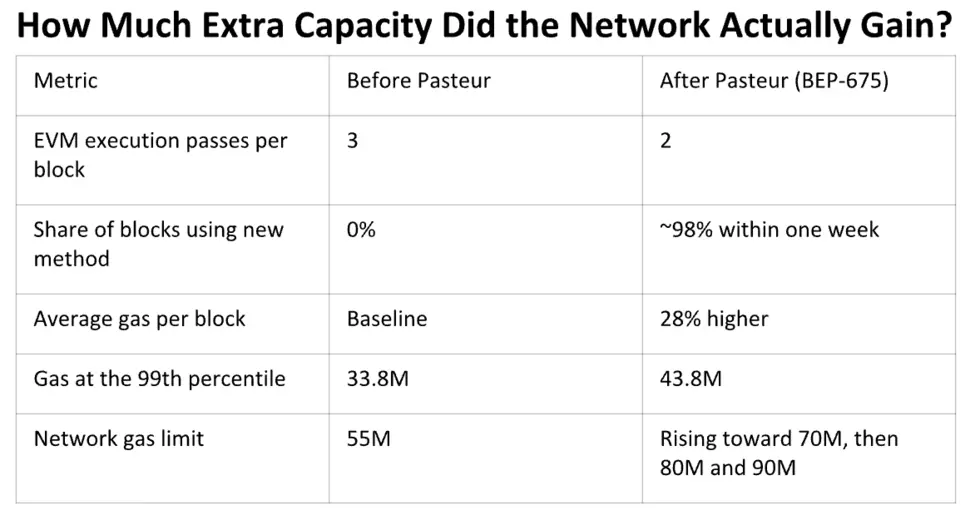
The table above is an engineering scorecard, not a trading indicator. A higher gas limit means
more room for complex transactions and more of them fitting into each block, precisely the kind of capacity a growing decentralized exchange or payments app would need as usage climbs.
People showing up to use that room, and paying for the privilege once they do, comes down to demand the chart by itself can't predict.
Running a brand-new system on live traffic surfaced problems a test environment simply couldn't have caught. BNB Chain engineers spotted 15 malformed blocks in the early days, traced the cause to one builder's misconfigured setup, patched it, and confirmed the issue never came back for the remainder of the observation window. That's unglamorous troubleshooting most press releases leave out, but it says a lot about how the rollout really got managed.
How carefully crypto businesses manage risk is something New Jersey readers have reason to care about: New Jersey 101.5 reported in November 2022 that Jersey City-based lender BlockFi had filed for Chapter 11 bankruptcy, with more than 100,000 creditors, after a major exchange collapsed.
Does Extra Network Capacity Predict Anything for BNB's Price?
American investors weighing this news are really facing two separate questions bundled together as one. Can the network handle more activity? Yes, clearly, the Pasteur data settles that. Will that added headroom turn into more transactions, more fees paid in BNB, and real demand for the token? That answer needs several more months before it shows up.
Richard Teng, Binance's co-CEO, framed a version of this tension back in December 2025, describing a coming change in the industry toward "moving beyond hype and speculation toward delivering real, scalable value" built on "purposeful adoption, trust, and long-term impact." A hard fork fixing redundant computation without any fanfare fits that description about as well as anything could. It also happens to be the kind of work that a price chart won't reward on the day it ships.
Genuine adoption looks like a specific set of things happening in practice:
- Decentralized exchanges and other high-volume apps pushing transaction volume up as the gas limit climbs toward 70M and beyond
- Validators keeping pace with larger blocks, without missing blocks or falling behind on synchronization
- Transaction fees paid in BNB climbing alongside network usage, a link between chain activity and the token that fee demand tends to make visible
- The builder market, currently concentrated among a handful of block producers, staying healthy as the system scales further
FAQ
Does BNB Chain's Pasteur upgrade guarantee BNB's price will rise? Not in any real sense. The upgrade proves real, measurable technical progress, but price answers to trading demand, market sentiment, and crypto-wide conditions that run on their own schedule.
How should someone compare a BNB price quote to this kind of technical news? Check the date on both. A price pulled today captures a distinct moment in the market from one pulled before the September 1 data or the mid-September gas limit increase, and pairing an old price with fresh engineering news is how people draw the wrong conclusion.

